
Complete George Washington biography – first U.S. president, commander of the Continental Army, and farmer. Learn his childhood, Revolutionary War leadership, slavery views, death, and lasting legacy.
George Washington (1732–1799) was the first President of the United States, the commander-in-chief of the Continental Army during the American Revolutionary War, and the president of the Constitutional Convention. More than any other person, he shaped the office of the presidency and the character of the young nation. His willingness to surrender power – first as military commander, later as president – set a global example of republican leadership.
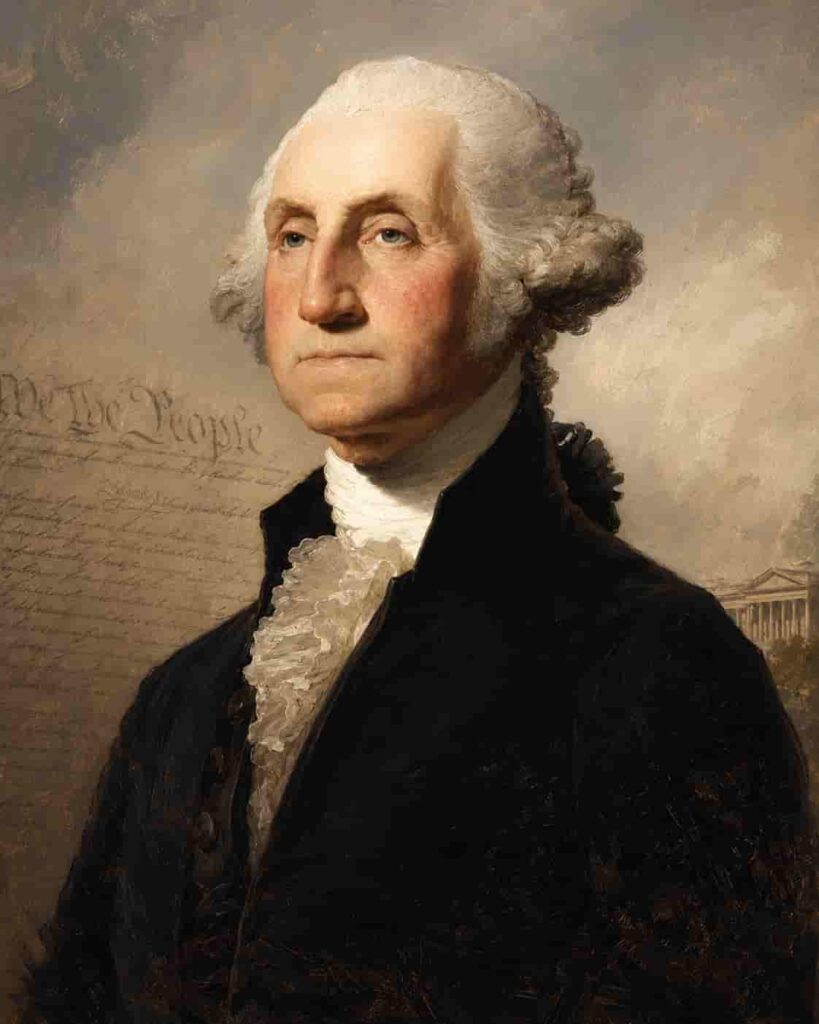
This biography covers Washington’s childhood, education, surveyor career, French and Indian War service, marriage, plantation management, Revolutionary War command, constitutional role, two presidential terms, retirement, death, and evolving views on slavery.
Childhood and Family Background
George Washington was born on February 22, 1732 (February 11 by the old-style Julian calendar) at Popes Creek Plantation in Westmoreland County, Virginia. His father, Augustine Washington, was a prosperous planter and a justice of the county court. His mother, Mary Ball Washington, was Augustine’s second wife.
Augustine’s first wife, Jane Butler, had died in 1729, leaving two sons – Lawrence and Augustine Jr. – and a daughter, Jane. George was the first child of Augustine and Mary’s union, followed by five siblings: Elizabeth, Samuel, John Augustine, Charles, and Mildred.
The Move to Ferry Farm
Around 1734, the family moved to Little Hunting Creek Plantation (later renamed Mount Vernon). In 1738, they relocated again to Ferry Farm on the Rappahannock River near Fredericksburg, Virginia. George spent most of his youth at Ferry Farm.
When George was 11, his father died. The majority of Augustine’s property went to George’s adult half-brothers. The remaining income barely supported Mary Washington and her younger children. As the eldest son of Mary’s household, George learned hard work and efficiency – lessons that would define his character.
Education: No College, But Practical Skills
Unlike many Virginia gentlemen, George Washington never attended college. His half-brothers Lawrence and Augustine Jr. had studied at Appleby Grammar School in England, but after their father’s death, the family lacked funds for such education. Instead, George received formal instruction from private tutors and possibly a local school in Fredericksburg.
He mastered reading, writing, basic legal forms, geometry, and trigonometry – the last two to prepare for a career as a land surveyor. He also studied manners and deportment, copying rules of civility that guided his conduct for life.
Surveying: The First Career
In 1748, at age 16, Washington joined a surveying party organized by his neighbor George William Fairfax. The month-long expedition into Virginia’s western frontier gave him practical experience in wilderness living and land measurement.
The following year, 1749, Washington received a commission as surveyor for Culpeper County – likely with help from William Fairfax, a member of the Governor’s Council. Surveying provided young Washington with income, land knowledge, and connections that would later fuel his land acquisitions.
The French and Indian War (1754–1763)
The Allegheny Expedition (1753)
Virginia Governor Robert Dinwiddie learned that French troops were building forts south of Lake Erie, on British-claimed land (modern western Pennsylvania). In the fall of 1753, Dinwiddie sent 21-year-old Major Washington to deliver a message demanding the French leave.
Washington traveled 900 miles in harsh winter conditions, aided by frontier guide Christopher Gist and Seneca chief Tanacharison (called “Half-King”). After delivering the message to Fort Le Boeuf, the return journey nearly killed him: he fell off a raft into the icy Allegheny River and spent a freezing night on an island. Dinwiddie published Washington’s account in Williamsburg and London, making the 22-year-old internationally known.
Jumonville Glen and Fort Necessity
In 1754, now a lieutenant colonel, Washington led 150 men to defend Virginia’s claims. His forces skirmished with French soldiers on May 28, killing 10 – including French commander Joseph Coulon de Villiers, Sieur de Jumonville. Washington then built a makeshift stockade called Fort Necessity. On July 3, the French surrounded and forced his surrender. This humiliating defeat ignited the global Seven Years’ War (called the French and Indian War in North America).
Braddock’s Defeat (1755)
Washington resigned his commission but volunteered as aide to British General Edward Braddock. On July 9, 1755, near the Monongahela River, Braddock’s army was ambushed and routed. Washington had two horses shot from under him and four bullet holes through his coat, yet he rallied survivors and led the retreat. His bravery became legendary.
Given command of Virginia’s entire military force, Washington spent years defending a 350‑mile frontier with only a few hundred men. In 1758, the British finally captured the forks of the Ohio (modern Pittsburgh). Washington resigned his commission and returned to Mount Vernon.
Marriage to Martha Dandridge Custis
On January 6, 1759, George Washington married Martha Dandridge Custis, a wealthy widow from Virginia’s Tidewater region. She was 27. Her first husband, Daniel Parke Custis, had left her considerable property, including 84 enslaved people (held as a “dower share” – she had life rights but not legal ownership). Martha also brought two young children: John “Jacky” and Martha “Patsy.”
Martha managed Mount Vernon’s domestic staff – butlers, housekeepers, maids, cooks, waiters, laundresses, spinners, seamstresses, and gardeners – while also raising her children. The happy years ended tragically in 1773 when 17‑year‑old Patsy suffered a seizure and died.
Entrepreneur and Farmer at Mount Vernon (1759–1775)
Between military service and the Revolution, Washington managed Mount Vernon as an innovative farmer. He switched from tobacco to wheat as his main cash crop in the 1760s, saving soil fertility. He experimented with fertilizers, crop rotation, new tools, and livestock breeding. He also built a gristmill for superfine flour and later – on his farm manager’s advice – one of America’s largest whiskey distilleries, producing over 11,000 gallons of rye whiskey annually.
Washington expanded Mount Vernon from 2,000 to 8,000 acres, with five farms and more than 3,000 acres under cultivation. He added wings to the mansion, raised the roof for a third floor, built a piazza overlooking the Potomac, and crowned it with a cupola.
Slavery at Mount Vernon
From age 11, when he inherited 10 enslaved people, Washington controlled more than 500 enslaved individuals by the end of his life – through inheritance, purchase, hire, and Martha’s dower share (which grew to 153 people by 1799 through natural increase).
Washington’s views on slavery evolved. Economic troubles and moral reflection after the Revolutionary War led him to question the institution, though he never publicly advocated abolition. In his will, he arranged to free the 123 enslaved people he owned outright (the dower slaves remained with the Custis estate). This was a rare act among Virginia’s founding elite.
Commander in Chief of the Continental Army (1775–1783)
In June 1775, the Second Continental Congress commissioned Washington to command the Continental Army besieging British forces in Boston. He had no experience leading large formations, handling cavalry or artillery, or maintaining supply lines for thousands. But he learned on the job – and his courage, determination, and mental agility kept the American cause alive.
Boston and New York
In March 1776, Washington forced the British to evacuate Boston. But a new British army under Sir William Howe arrived to take New York City – a near‑impossible city to defend due to its waterways and British naval superiority. Washington was defeated at Long Island (August 1776), routed at Kip’s Bay, and beaten again at White Plains. Fort Washington fell on November 16, with 2,800 Americans captured. Washington retreated across New Jersey and crossed the Delaware River into Pennsylvania on December 7.
Trenton and Princeton (Christmas 1776)
With enlistments expiring at month’s end, Washington launched a daring counterstrike. On Christmas night, his troops crossed the icy Delaware and surprised the Hessian garrison at Trenton, forcing its surrender. Days later, he outmaneuvered a British relief force and struck again at Princeton. These twin victories revived American morale.
The Long War of Attrition
For much of the war, Washington’s strategic goal was to keep the British bottled up in New York, avoiding a decisive defeat. An alliance with France (1778) and the arrival of the Comte de Rochambeau’s army (1780) renewed hopes of recapturing New York – but the combined force was still outnumbered.
Instead, Washington and Rochambeau marched south to Virginia, laying siege to Lord Cornwallis’s army at Yorktown. On October 19, 1781, Cornwallis surrendered. Though peace took two more years, Yorktown effectively ended the Revolutionary War.
Resigning Power (December 23, 1783)
On December 23, 1783, Washington appeared before Congress in Annapolis, Maryland, and resigned his commission as commander-in-chief. This act – modeled on the Roman hero Cincinnatus – was without precedent in modern history. He could have seized power or become a king. Instead, he went home to Mount Vernon.
The Constitutional Convention (1787)
After the war, Washington watched the weak Articles of Confederation fail. By 1785, he wrote to James Madison that the nation needed “an energetic Constitution.” In 1787, he ended his retirement to attend the Philadelphia convention, where he was unanimously elected president of the proceedings.
Washington spoke rarely during the four‑month convention, but his presence lent legitimacy. He wished the delegates to “probe the defects of the Constitution to the bottom and provide a radical cure.” After the convention, he tirelessly supported ratification. Virginia’s approval passed by just one vote.
Presidency (1789–1797)
First Term (1789–1793)
Every elector voted for Washington – the only unanimous presidential election in U.S. history. He organized the executive branch, appointed Alexander Hamilton (Treasury), Thomas Jefferson (State), and Henry Knox (War), and established administrative procedures for energy and efficiency.
In his First Inaugural Address, he admitted being “unpracticed in civil administration,” but he proved to be a superb administrator. Thomas Jefferson later wrote: “His integrity was most pure, his justice the most inflexible I have ever known.”
Key achievements of the first term:
· Hamilton’s financial plan (federal assumption of state debts, national bank)
· Peace treaties with southeastern Indian tribes
· Selection of the permanent capital on the Potomac River (Washington, D.C.)
Second Term (1793–1797)
The French Revolution triggered a European war. Washington declared American neutrality – a foundational foreign policy principle that kept the young nation out of war while it grew economically.
Domestically, the Whiskey Rebellion (1794) saw Pennsylvania distillers riot against a federal tax. Washington led the army to restore order, demonstrating federal authority. Partisanship deepened between Federalists (Hamilton) and Republicans (Jefferson, Madison), a development Washington deeply regretted.
Important second‑term successes:
· Victory in the long northwestern Indian war
· British surrender of Great Lakes forts (Jay Treaty)
· Spain opened the Mississippi River to American commerce
Farewell Address
Washington’s Farewell Address (published 1796, not spoken) warned against:
· Permanent foreign alliances
· Sectional factionalism
· The spirit of party (partisanship)
· Excessive public debt
Retirement and Death (1797–1799)
Washington finally retired to Mount Vernon in March 1797. He spent his final years improving the estate and welcoming visitors.
Fatal Illness
On Thursday, December 12, 1799, Washington rode out in freezing weather – snow, hail, then rain. He returned with a sore throat but refused to change before dinner out of punctuality. By early morning on December 13, he struggled to breathe.
Doctors James Craik, Gustavus Brown, and Elisha Dick performed bloodletting (four times), induced vomiting, and administered enemas and sage tea – standard but harmful treatments. Historians now believe he died of acute bacterial epiglottitis or a severe throat infection.
On December 14, 1799, between 10 and 11 p.m., George Washington died at age 67. His last words were “‘Tis well.” His body lay in the New Room for three days, then a funeral was held on December 18 at Mount Vernon. He was buried in the family tomb.
Washington’s Will
Washington wrote his will several months before his death. It freed the 123 enslaved people he personally owned (effective upon Martha’s death – though Martha freed them in December 1800, fearing a plot). The will also provided pensions for elderly enslaved workers and education for younger ones.
Legacy
George Washington is remembered as the “Father of His Country.” His refusal to seek power, his establishment of civilian control over the military, and his two‑term limit precedent (later made law by the 22nd Amendment) shaped the American presidency. His image adorns the one‑dollar bill and the quarter. The nation’s capital, Washington, D.C., is named for him.
“First in war, first in peace, and first in the hearts of his countrymen.” – Henry Lee
Sources for Further Reading:
● Mount Vernon Ladies’ Association (mountvernon.org)
● Library of Congress: George Washington Papers
● National Archives: Founders Online