
Complete biography of Abraham Lincoln, the 16th U.S. president. Learn about his childhood in Kentucky, self-taught law career, Lincoln-Douglas debates, Emancipation Proclamation, Gettysburg Address, Civil War leadership, assassination, and enduring legacy.
Abraham Lincoln: Complete Biography of the 16th President
Abraham Lincoln (February 12, 1809 – April 15, 1865) was the 16th president of the United States, serving from 1861 until his assassination in 1865. He led the nation through its greatest moral, constitutional, and political crisis – the American Civil War. Lincoln preserved the Union, abolished slavery, strengthened the federal government, and modernized the economy. His eloquence, humility, and political skill have made him one of America’s most revered presidents.
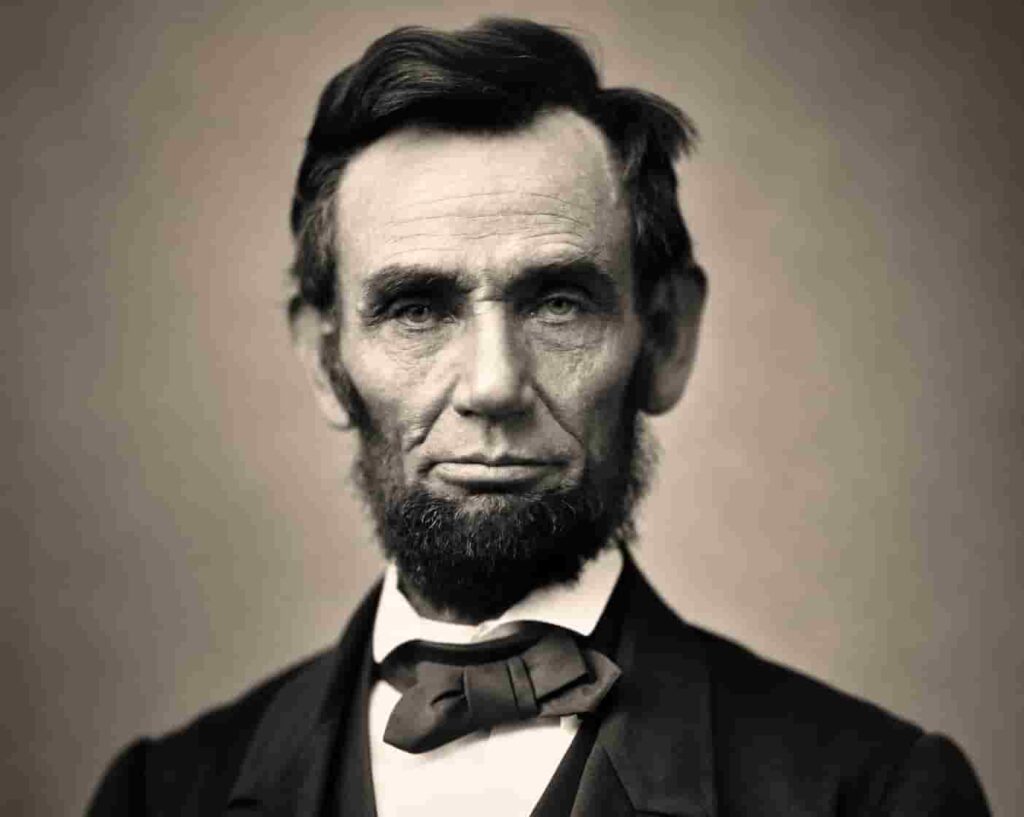
| Born | February 12, 1809, near Hodgenville, Kentucky |
|---|---|
| Died | April 15, 1865, Washington D.C. (aged 56) |
| Presidency | March 4, 1861 – April 15, 1865 |
| Political Party | Republican (formerly Whig) |
| Vice President |
Hannibal Hamlin (1861–1865) Andrew Johnson (1865) |
| Nicknames | Honest Abe, The Great Emancipator, The Rail-Splitter |
| Spouse | Mary Todd Lincoln (m. 1842) |
| Children | Robert, Edward, William, Thomas |
Childhood in Kentucky and Indiana
Abraham Lincoln was born in a one-room log cabin on the Sinking Spring Farm, three miles south of Hodgenville, Kentucky. His father, Thomas Lincoln, was a farmer and carpenter who could barely read and write. His mother, Nancy Hanks Lincoln, was described by those who knew her as intelligent and deeply religious.
When Abraham was two, the family moved to a farm on Knob Creek, where his earliest memory involved a flash flood washing away his father’s crops. In 1816, due to a land dispute, Thomas Lincoln moved the family across the Ohio River to Perry County, Indiana – then a near-wilderness. They built a “half-faced camp” (a shelter open on one side) and survived a bitterly cold winter.
Abraham’s mother died in 1818 from “milk sickness” (poisoning from drinking milk from cows that had eaten white snakeroot). The nine-year-old boy helped his father carve pegs for her coffin. Years later, he recalled: “God bless my mother; all that I am or ever hope to be I owe to her.”
The family’s fortunes improved after Thomas Lincoln remarried in 1819. Sarah Bush Johnston, a widow with three children of her own, brought books, energy, and affection. She encouraged Abraham’s love of reading – a habit that set him apart from his peers.
Self‑Education: By Littles
Lincoln attended school “by littles” – a few weeks here, a few months there – for a total of less than one year. Yet he became a voracious reader. He walked miles to borrow books, including:
· The Life of George Washington by Parson Weems (including the cherry tree myth)
· Robinson Crusoe by Daniel Defoe
· The Pilgrim’s Progress by John Bunyan
· Aesop’s Fables
He also read the King James Bible so thoroughly that he could quote long passages from memory later in life. His stepmother recalled that he would “read everything he could lay his hands on” and would “never stop until he understood every word.”
Early Career: Rail-Splitter, Flatboatman, Storekeeper
In 1830, the Lincoln family moved again – this time to Macon County, Illinois. Abraham, now 21, struck out on his own. He split rails to fence new farms (earning the nickname “Rail-Splitter”). He also made a flatboat trip down the Mississippi River to New Orleans, where he witnessed a slave auction – an experience that reportedly disturbed him greatly.
Settling in the small village of New Salem, Illinois, Lincoln worked as a storekeeper, postmaster, and surveyor. He gained a reputation for honesty and strength. A famous story: when he shortchanged a customer by a few cents, he walked several miles that evening to return the money.
The Black Hawk War (1832)
When the Black Hawk War broke out, Lincoln volunteered and was elected captain of his company – his first experience leading men. He later joked that he saw no “live, fighting Indians” but fought many “bloody struggles with the mosquitoes.” The war ended quickly, but Lincoln’s brief service gave him political visibility.
Entry into Politics and the Illinois Legislature
Lincoln lost his first election for the Illinois General Assembly in 1832 but won two years later. He served four consecutive terms (1834–1841) as a Whig. He supported internal improvements (canals, railroads, roads) and a national bank – policies he admired from Henry Clay and Daniel Webster.
While in the legislature, Lincoln taught himself law. He borrowed law books from a friend, studied at night, and passed the bar examination in 1836. He moved to Springfield, Illinois (the new state capital) the next year and began practicing law.
Lawyer on the Circuit
For nearly 20 years, Lincoln rode the Eighth Judicial Circuit – traveling by horse or buggy to county courthouses across central Illinois. He handled thousands of cases, from petty disputes to murder trials. His most famous case was the “Almanac Trial” (1858). He defended William “Duff” Armstrong, accused of murder. A witness claimed moonlight allowed him to see the crime. Lincoln produced an almanac showing the moon was low on that night, creating insufficient light. The jury acquitted.
Lincoln’s legal reputation rested on honesty: he told clients not to sue if he believed they were wrong. He once said, “If I can free a man from a false charge of crime without trying the case, I will do it.”
Marriage to Mary Todd
In 1839, Lincoln met Mary Todd, a well-educated woman from a wealthy Kentucky slaveholding family. After a rocky courtship (including a broken engagement in 1841, which plunged Lincoln into deep depression), they married on November 4, 1842.
The Lincolns had four sons:
· Robert Todd Lincoln (1843–1926) – the only child to survive to adulthood
· Edward Baker Lincoln (1846–1850) – died at age 3
· William Wallace “Willie” Lincoln (1850–1862) – died in the White House, probably from typhoid
· Thomas “Tad” Lincoln (1853–1871) – died at age 18
Mary Todd Lincoln supported her husband’s ambitions but also struggled with headaches, depression, and compulsive spending. During the Civil War, she was criticized for lavish White House renovations while soldiers suffered. Despite strains, letters between the couple show genuine affection.
One Term in Congress (1847–1849)
Lincoln served a single term in the U.S. House of Representatives. He opposed the Mexican-American War (1846–1848), believing President James K. Polk had provoked it. His “Spot Resolutions” demanded to know the exact spot where American blood was shed on American soil – a bold move that hurt his popularity in Illinois.
He also introduced a bill for gradual, compensated emancipation of enslaved people in Washington, D.C. The bill went nowhere, but it foreshadowed his later policies. After his term, Lincoln returned to his law practice, seemingly finished with politics.
The Kansas‑Nebraska Act and the Return to Politics
In 1854, Senator Stephen A. Douglas pushed the Kansas-Nebraska Act through Congress. It repealed the Missouri Compromise (1820) and allowed settlers in those territories to decide for themselves whether to allow slavery – a doctrine called “popular sovereignty.”
Lincoln was outraged. He spoke passionately against the act, calling slavery a “monstrous injustice.” The act destroyed the Whig Party and gave birth to the Republican Party, which opposed the extension of slavery into the territories. Lincoln joined the Republicans in 1856.
Lincoln‑Douglas Debates (1858)
When Lincoln ran against Douglas for the U.S. Senate in 1858, he challenged Douglas to a series of seven debates across Illinois. Thousands attended. Douglas defended popular sovereignty; Lincoln argued that slavery was a moral evil that the nation could not ignore. He famously said:
“A house divided against itself cannot stand. I believe this government cannot endure permanently half slave and half free.”
Lincoln lost the Senate race, but the debates made him a national figure. He collected the transcripts into a book that boosted his reputation.
Presidential Election of 1860
On May 18, 1860, the Republican National Convention in Chicago nominated Lincoln on the third ballot. His platform opposed slavery extension but promised not to interfere with slavery where it existed.
The Democratic Party split into Northern (Douglas) and Southern (John C. Breckinridge) factions. A fourth candidate, John Bell of the Constitutional Union Party, also ran. Lincoln won a majority of the electoral college (180 out of 303) while receiving only 40% of the popular vote. He carried no Southern state.
Seven Southern states seceded before he even took office, forming the Confederate States of America.
Presidency (1861–1865)
First Inaugural Address (March 4, 1861)
Lincoln traveled to Washington in disguise due to assassination threats. In his inaugural address, he appealed to Southerners: “We are not enemies, but friends. We must not be enemies.” He pledged to hold federal property but not to attack the South unless provoked. The Confederate government ignored him.
The Firing on Fort Sumter
On April 12, 1861, Confederate forces bombarded Fort Sumter in Charleston Harbor, South Carolina. The garrison surrendered after 34 hours. Lincoln called for 75,000 volunteers to suppress the rebellion. In response, Virginia, Arkansas, Tennessee, and North Carolina seceded. The Civil War had begun.
Wartime Leadership and Strategy
Lincoln struggled to find effective generals. He fired George B. McClellan for being too cautious (“the slows”), then John Pope, Ambrose Burnside, Joseph Hooker, and George Meade. Finally, in March 1864, he gave overall command to Ulysses S. Grant, who shared Lincoln’s vision of coordinated, total war.
Key strategic moves:
· Naval blockade of Southern ports
· Control of the Mississippi River (accomplished by Grant’s victory at Vicksburg, July 4, 1863)
· Sherman’s March to the Sea (1864) – cutting the Confederacy in half
Lincoln also suspended the writ of habeas corpus in border states, allowing arrest of suspected Confederate sympathizers without trial. He defended this as necessary to preserve the Union.
The Emancipation Proclamation
Lincoln had long disliked slavery but moved cautiously. On September 22, 1862, after the Union victory at Antietam, he issued a preliminary Emancipation Proclamation. The final proclamation, effective January 1, 1863, declared all enslaved people in Confederate-held territory “forever free.” It did not apply to border states or areas under Union control, but it reframed the war as a fight for human freedom. It also allowed Black men to enlist in the Union Army – nearly 200,000 did by war’s end.
Lincoln then pushed Congress to pass the Thirteenth Amendment, which abolished slavery throughout the United States. The amendment passed in January 1865 and was ratified that December – after Lincoln’s death.
The Gettysburg Address (November 19, 1863)
At the dedication of the Soldiers’ National Cemetery in Gettysburg, Pennsylvania, Lincoln delivered a 272‑word speech that became one of the most quoted in history. He declared that the nation was “conceived in liberty” and that the war was a test of whether “government of the people, by the people, for the people, shall not perish from the earth.”
Reelection in 1864
Many expected Lincoln to lose. The war was costly and unpopular. But Union military successes (Atlanta fell in September 1864) boosted his campaign. He defeated his former general, George B. McClellan, winning 55% of the popular vote and 212 of 233 electoral votes.
Second Inaugural Address (March 4, 1865)
With Union victory near, Lincoln offered a message of reconciliation:
“With malice toward none; with charity for all … let us strive on to finish the work we are in; to bind up the nation’s wounds.”
Assassination – April 14, 1865
Just five days after Confederate General Robert E. Lee surrendered at Appomattox, Lincoln attended a performance of Our American Cousin at Ford’s Theatre in Washington, D.C. John Wilkes Booth, a 26‑year‑old actor and Confederate sympathizer, crept into the presidential box and shot Lincoln in the back of the head.
Lincoln was carried across the street to the Petersen House. He never regained consciousness and died at 7:22 a.m. on April 15, 1865. Secretary of War Edwin Stanton reportedly said, “Now he belongs to the ages.”
Booth fled and was killed by Union troops 12 days later. Eight other conspirators were tried; four were hanged.
Legacy: Why Lincoln Endures
Abraham Lincoln saved the Union, ended legal slavery, and redefined the presidency. His speeches – the Gettysburg Address, the Second Inaugural, the House Divided speech – are studied as models of political rhetoric.
Major memorials and tributes:
· Lincoln Memorial (Washington, D.C., dedicated 1922)
· Mount Rushmore (carved alongside Washington, Jefferson, and Roosevelt)
· U.S. penny (since 1909) and five‑dollar bill
· Lincoln’s birthday (observed in many states, combined with Presidents’ Day)
Historians consistently rank Lincoln as one of the top three U.S. presidents, often #1. His humility, humor, moral clarity, and ability to grow in office continue to inspire leaders worldwide.
“Lincoln was not a man of his time; he was a man for all time.” – Unknown
Sources for Further Reading :
● Abraham Lincoln Presidential Library and Museum (Springfield, Illinois)
● Library of Congress: Abraham Lincoln Papers
● National Archives: Emancipation Proclamation and Gettysburg Address