
Complete biography of Franklin D. Roosevelt (FDR), the 32nd U.S. president. Learn about his New Deal, leadership during the Great Depression and World War II, polio struggle, four terms, and lasting legacy.
Biography Of Franklin D. Roosevelt
Franklin Delano Roosevelt (January 30, 1882 – April 12, 1945), often referred to by his initials FDR, was the 32nd president of the United States, serving from 1933 until his death in 1945. He is the only American president elected to four terms. Roosevelt led the nation through two of its greatest crises – the Great Depression and World War II. He created the New Deal, expanded the federal government, and became the principal architect of the Allied victory against Nazi Germany and Imperial Japan.
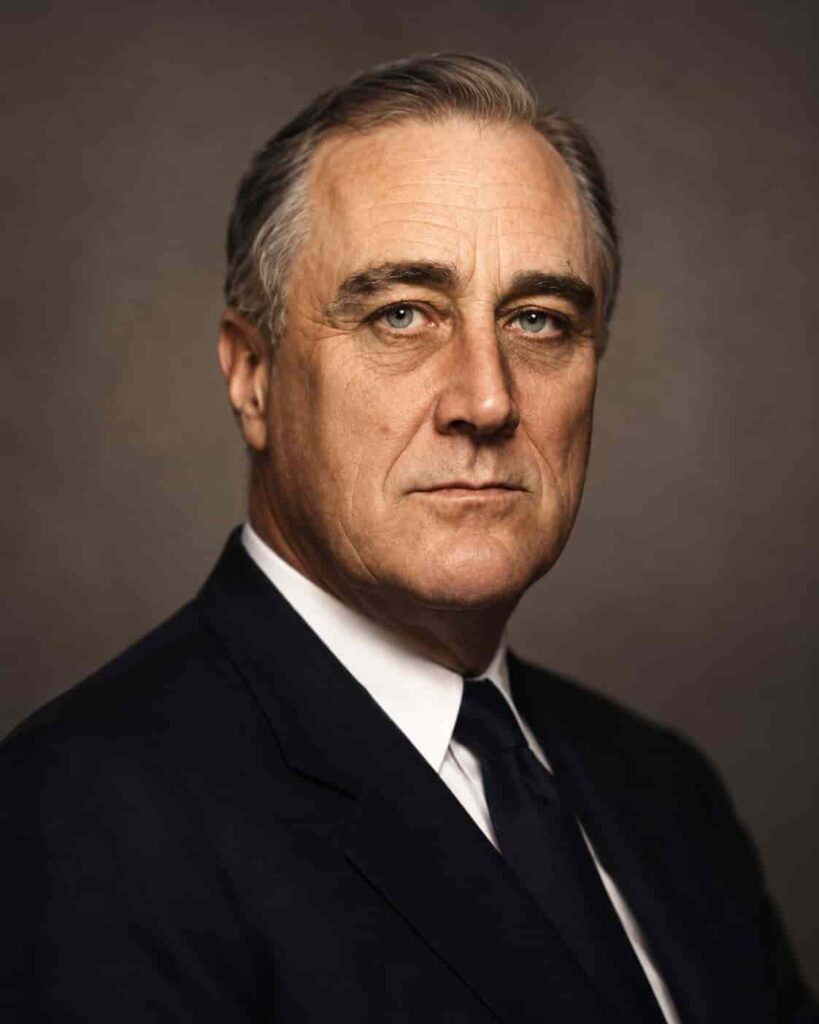
| Born | January 30, 1882, Hyde Park, New York |
|---|---|
| Died | April 12, 1945, Warm Springs, Georgia (aged 63) |
| Presidency | March 4, 1933 – April 12, 1945 |
| Political Party | Democratic Party |
| Vice Presidents |
John Nance Garner (1933–1941) Henry A. Wallace (1941–1945) Harry S. Truman (1945) |
| Nickname | FDR |
| Spouse | Eleanor Roosevelt (m. 1905) |
1. Early Life and Family Background
Franklin Delano Roosevelt was born into wealth and privilege at his family’s estate in Hyde Park, New York, overlooking the Hudson River. He was the only child of James Roosevelt, a successful railroad executive and landowner, and Sara Delano Roosevelt, who came from a wealthy shipping and trading family.
The Roosevelts lived a life of “genteel luxury,” dividing their time between Hyde Park and European resorts. Young Franklin was educated by private tutors until age 14, learning French, German, Latin, and history. He was raised with a strong sense of Christian stewardship – the belief that wealthy families had a duty to serve the less fortunate through public service.
Groton Preparatory School (1896–1900)
At age 14, Roosevelt entered Groton School in Massachusetts. The headmaster, Endicott Peabody, instilled in students a responsibility to help the poor and to enter politics as a form of moral duty. Although Roosevelt was not a standout student, the Groton ethos shaped his character for life.
3. Harvard University and Columbia Law (1900–1907)
Roosevelt entered Harvard University in 1900. He spent more time on extracurricular activities – including serving as editor of the Harvard Crimson newspaper – than on academics. His grades were unremarkable, but he absorbed the progressive political philosophy of his fifth cousin, President Theodore Roosevelt, who advocated for government intervention in the economy.
Marriage to Eleanor Roosevelt
During his Harvard years, Franklin fell in love with Eleanor Roosevelt, Theodore Roosevelt’s niece. They were engaged during his senior year and married on March 17, 1905. President Theodore Roosevelt attended the wedding.
After Harvard, Franklin attended Columbia Law School but found the study of law boring. He passed the New York bar exam in 1907 without graduating and took a clerking job at a Wall Street firm. He was indifferent to corporate law and soon looked for an exit into politics.
3. Early Political Career (1910–1920)
New York State Senate (1911–1913)
In 1910, Democratic Party leaders in Dutchess County asked Roosevelt to run for the New York State Senate – a race they considered unwinnable. Roosevelt campaigned tirelessly and won in a surprise upset.
Once in Albany, he quickly gained attention by leading a group of Democratic insurgents who refused to support the Tammany Hall candidate for U.S. Senate. For three months, Roosevelt held his small group together, and Tammany eventually backed down. This fight made him a progressive hero.
Assistant Secretary of the Navy (1913–1920)
Roosevelt supported Woodrow Wilson’s presidential campaign in 1912. As a reward, Wilson appointed him Assistant Secretary of the Navy – the same job Theodore Roosevelt had used as a stepping stone.
Roosevelt loved naval affairs. He worked to modernize navy yards, negotiated with labor unions, and became an advocate of military preparedness as World War I engulfed Europe. After the United States entered the war in 1917, he proved himself an able administrator, traveling to Europe in 1918 to inspect naval bases and battlefields.
Personal Crisis: The Lucy Mercer Affair
During his European tour, Eleanor discovered that Franklin had been romantically involved with her social secretary, Lucy Mercer. Eleanor offered a divorce; Franklin refused, partly because divorce would end his political career. He promised never to see Mercer again – a promise he would break in the 1940s. The marriage survived but became a political partnership rather than a romantic one.
Vice Presidential Nomination (1920)
At the 1920 Democratic convention, Roosevelt was nominated for vice president on a ticket with presidential candidate James M. Cox. Roosevelt campaigned vigorously for American entry into the League of Nations. The Cox-Roosevelt ticket lost in a landslide to Warren G. Harding and Calvin Coolidge.
After the defeat, Roosevelt became vice president of the Fidelity and Deposit Company of Maryland and dabbled in other business ventures. He seemed to be drifting away from politics.
4. Polio and Personal Transformation (1921–1928)
In August 1921, while vacationing at the family cottage on Campobello Island, New Brunswick, Roosevelt was stricken with poliomyelitis (polio). He lost almost all movement in his legs. For weeks, he could not even sit up without help. His mother urged him to retire quietly to Hyde Park, but his wife Eleanor and his political adviser Louis McHenry Howe insisted he remain in public life.
Roosevelt never accepted that he would be permanently paralyzed. He spent years trying various treatments, including swimming in Warm Springs, Georgia (which later became his therapeutic retreat). He learned to use crutches and a wheelchair but could never again walk unaided.
Eleanor Roosevelt as Political Surrogate
During his recovery, Eleanor became his eyes and ears. She gave speeches, attended meetings, and kept his name alive in Democratic circles. Initially shy, she grew into a powerful public speaker and political analyst under Howe’s guidance. Without her, FDR’s political career would likely have ended.
Return to Politics – Governor of New York (1929–1932)
In 1924 and again in 1928, Roosevelt nominated Alfred E. Smith for president at the Democratic National Conventions. Smith, the governor of New York, urged Roosevelt to run for his seat in 1928. Roosevelt reluctantly agreed and won the election by 25,000 votes – even as Herbert Hoover carried New York in the presidential election.
As governor during the early years of the Great Depression, Roosevelt moved aggressively. He created the Temporary Emergency Relief Administration in 1931, which eventually provided unemployment assistance to 10% of New York’s families. His decisive action, combined with his landslide reelection in 1930 (by 725,000 votes), made him the front-runner for the Democratic presidential nomination in 1932.
5. Presidential Election of 1932
Roosevelt faced strong opposition from Al Smith and urban conservatives. On the third ballot at the Democratic convention, John Nance Garner of Texas (the Speaker of the House) released his delegates, and Roosevelt won the nomination on the fourth ballot. Garner became his vice president.
Breaking tradition, Roosevelt flew to Chicago to accept the nomination in person. He told the delegates:
“I pledge you, I pledge myself, to a new deal for the American people.”
In the general election, Roosevelt faced incumbent Republican President Herbert Hoover, whose popularity had collapsed amid the Depression. Roosevelt offered a vaguely defined “New Deal” that promised extensive federal action, while Hoover defended voluntary cooperation and limited government.
On election day, Roosevelt won 22.8 million popular votes to Hoover’s 15.8 million, and the electoral college vote was 472 to 59. Democrats also won huge majorities in both houses of Congress.
6. First Term (1933–1937) – The Hundred Days and the New Deal
By the time Roosevelt took office on March 4, 1933, most of America’s banks had closed, industrial production had fallen to 56% of its 1929 level, and at least 13 million people were unemployed (25% of the workforce).
In his First Inaugural Address, Roosevelt famously declared:
“The only thing we have to fear is fear itself.”
He promised prompt, decisive action – and delivered.
The Hundred Days (March – June 1933)
Roosevelt called Congress into special session and passed 15 major laws in just over three months. Key measures included:
| Emergency Banking Act | Closed all banks and reopened only financially sound banks, helping end bank runs. |
|---|---|
| Federal Deposit Insurance Corporation (FDIC) | Protected depositors’ savings under the Glass-Steagall Act. |
| Civilian Conservation Corps (CCC) | Employed around 2.5 million young men in reforestation and flood control projects. |
| Agricultural Adjustment Act (AAA) | Paid farmers to reduce production, helping raise crop prices. |
| Tennessee Valley Authority (TVA) | Built dams and provided cheap electricity to seven states. |
| National Industrial Recovery Act (NIRA) | Created the NRA for wage and price codes and the PWA for public works spending. |
| Federal Securities Act | Created the SEC to regulate stock trading and reduce fraud. |
Fireside Chats
Roosevelt mastered the new medium of radio. His “fireside chats” – informal, direct addresses to the American people – built public trust. The first chat, on banking, convinced millions to redeposit their money when banks reopened.
Criticisms of the First New Deal
The NRA became enormously complex and ineffective. By 1935, the Supreme Court had begun striking down New Deal laws, including the NRA. Businessmen turned against Roosevelt, accusing him of socialism.
Second Term (1937–1941) – The Second New Deal and Court-Packing
The Second New Deal (1935)
Roosevelt realized that recovery was too slow. In 1935, he pushed through a “Second New Deal” with three landmark laws:
- Social Security Act (1935) – Created old-age pensions, unemployment insurance, and aid to dependent children. For the first time, Americans had an economic safety net.
- Works Progress Administration (WPA) – Employed millions of workers building roads, bridges, airports, schools, and hospitals. The WPA also funded artists, writers, and musicians – including murals in public buildings and the Federal Writers’ Project.
- Wagner Act (National Labor Relations Act) – Guaranteed workers the right to form unions and bargain collectively. The National Labor Relations Board (NLRB) enforced these rights.
The Court-Packing Plan (1937)
After his landslide reelection in 1936 (carrying every state except Maine and Vermont), Roosevelt became frustrated with the Supreme Court, which had invalidated several New Deal laws. He proposed a bill allowing the president to appoint one new justice for every sitting justice over age 70 – up to six new justices.
Even his allies called this “court-packing.” The bill failed after a bitter debate. However, the court’s opposition to the New Deal softened afterward – the Social Security Act and Wagner Act were upheld.
The Recession of 1937–1938
Believing recovery was secure, Roosevelt cut government spending in 1937. The economy plunged again – industrial production dropped 40%, and unemployment soared to 20%. Chastened, Roosevelt reversed course and approved massive deficit spending in 1938. The crisis passed, but the recession damaged his reputation as an economic master.
End of the New Deal
By 1938, a coalition of conservative Democrats and Republicans blocked further reform. Roosevelt attempted to purge anti-New Deal Democrats in the 1938 primaries – but failed, creating lasting political wounds.
8. Foreign Policy (1933–1941) – From Isolationism to War
Early Foreign Policy
Roosevelt recognized the Soviet Union in 1933. He launched the Good Neighbor Policy toward Latin America, withdrawing U.S. Marines from Haiti and Nicaragua. He also backed reciprocal trade agreements to lower tariffs.
Rising Threats – Germany, Italy, Japan
Congress, however, was dominated by isolationists who wanted to avoid another European war. Beginning with the Neutrality Act of 1935, Congress passed laws banning arms sales to belligerents.
Roosevelt warned Americans about the dictators – Adolf Hitler in Germany, Benito Mussolini in Italy, and militarists in Japan. In his “Quarantine Speech” (Chicago, October 1937), he called on peace-loving nations to “quarantine” aggressors. Isolationist backlash forced him to retreat.
Moving Toward War (1939–1941)
When World War II broke out in September 1939, Roosevelt pushed Congress to revise neutrality laws to allow “cash-and-carry” – Britain and France could buy American arms if they paid cash and transported them.
After France fell to Germany in June 1940, Roosevelt moved faster. He sent 50 older destroyers to Britain in exchange for eight naval bases. In March 1941, he obtained Lend-Lease – allowing the U.S. to send weapons to Britain without immediate payment.
In August 1941, Roosevelt met British Prime Minister Winston Churchill off Newfoundland and issued the Atlantic Charter – a joint statement of war aims, including self-determination, freedom of the seas, and disarmament of aggressors.
By fall 1941, Roosevelt ordered the U.S. Navy to “shoot on sight” at German submarines – undeclared naval war.
9.Third and Fourth Terms (1941–1945) – World War II
Breaking the Two-Term Tradition
In 1940, Roosevelt ran for an unprecedented third term. His Republican opponent, Wendell Willkie, agreed on foreign policy but criticized Roosevelt’s attempt to break tradition. Roosevelt won 27 million to 22 million popular votes – a closer race than before.
Pearl Harbor – December 7, 1941
On December 7, 1941, Japanese aircraft bombed the U.S. naval base at Pearl Harbor, Hawaii, destroying most of the Pacific fleet and killing 2,403 Americans. The next day, Roosevelt addressed Congress, calling December 7 “a date which will live in infamy.” Congress declared war on Japan with one dissenting vote. Germany and Italy declared war on the United States on December 11.
Dr. New Deal Becomes Dr. Win the War
Roosevelt told a press conference in 1943: “Dr. New Deal is being replaced by Dr. Win the War.” The wartime economy ended the Great Depression. Unemployment vanished as factories produced tanks, planes, and ships. The WPA and CCC were shut down.
Allied Strategy – “Europe First”
Roosevelt and Churchill agreed on a “Europe First” strategy – defeat Germany before Japan. Key decisions included:
· North Africa (1942) – Operation Torch
· Italy (1943) – Invasion of Sicily and the Italian mainland
· D-Day (June 6, 1944) – Invasion of Normandy
· Pacific Island-Hopping – Under Admiral Nimitz and General MacArthur
Wartime Conferences
| Casablanca Conference |
Date: January 1943 “Unconditional surrender” was demanded from the Axis Powers. |
|---|---|
| Tehran Conference |
Date: November – December 1943 First meeting with Stalin; leaders agreed to invade France in 1944. |
| Yalta Conference |
Date: February 1945 Germany was divided into occupation zones, and Stalin agreed to enter the war against Japan. |
Human Rights and Controversies
Roosevelt championed the Four Freedoms (1941): freedom of speech, freedom of worship, freedom from want, freedom from fear. These became the basis for the Universal Declaration of Human Rights.
However, a major blot on his record was Executive Order 9066 (February 1942), which authorized the internment of 120,000 Japanese Americans (two-thirds of them U.S. citizens) in inland camps. In 1988, the U.S. government officially apologized and paid reparations.
Health Decline and Fourth Inauguration (1945)
By 1944, Roosevelt’s health was failing. Doctors found severe hypertension and heart disease, but they kept the information from the public. Despite his frailty, he ran for a fourth term in 1944 with Harry S. Truman as vice president (replacing Henry Wallace). He defeated Thomas E. Dewey.
On March 1, 1945, Roosevelt addressed Congress after returning from Yalta. He looked gaunt and ill. On April 12, 1945, while sitting for a portrait in Warm Springs, Georgia, he collapsed from a massive cerebral hemorrhage. He died at 3:35 p.m., aged 63.
Vice President Harry S. Truman was sworn in that evening. Eleanor Roosevelt was told by a reporter, “The president is dead.” She replied, “The story is for you.” Then she flew to Warm Springs to bring her husband home.
10. Assassination Attempt? (Clarification)
Unlike several other presidents, FDR was never assassinated. He died of natural causes – a stroke. (Some sources confuse this with an assassination attempt in Miami in 1933, when an unemployed bricklayer fired shots at Roosevelt but missed, killing Chicago Mayor Anton Cermak instead.)
11. Legacy: Why FDR Still Matters
Franklin D. Roosevelt transformed the American presidency and the federal government. His legacy includes:
| Social Security | Old-age pensions still protect millions of elderly citizens. |
|---|---|
| FDIC | Bank deposits are insured, and there have been no major bank runs since 1933. |
| SEC | Stock markets are regulated to reduce fraud and protect investors. |
| Minimum Wage | Established by the Fair Labor Standards Act in 1938. |
| Tennessee Valley Authority | Continues to provide cheap electricity to many regions. |
| New Deal Infrastructure | Schools, hospitals, bridges, and dams built during the New Deal are still in use today. |
| Lend-Lease Program | Helped Allied nations defeat Nazi Germany during World War II. |
| United Nations | Roosevelt coined the name “United Nations” and strongly supported its creation. |
Memorials and Tributes
· Franklin D. Roosevelt Memorial – Washington, D.C. (dedicated 1997)
· FDR dime – He appears on the dime (chosen because he helped found the March of Dimes to fight polio)
· Mount Rushmore – Not included (only Washington, Jefferson, Roosevelt [Teddy], and Lincoln)
· Franklin D. Roosevelt Presidential Library – Hyde Park, New York (first presidential library)
· Ranking – Historians consistently rank FDR among the top three U.S. presidents, along with Lincoln and Washington
Criticism and Controversy
· Japanese American internment – Widely condemned as a violation of civil liberties
· Court-packing attempt – Seen as a power grab
· Breaking the two-term tradition – Led to the 22nd Amendment (1951), limiting presidents to two terms
· Relations with Stalin – Critics say he trusted Stalin too much at Yalt.
Franklin D. Roosevelt led the United States through the two greatest crises of the 20th century. He gave Americans hope during the Depression and led the Allies to victory in World War II. His New Deal permanently reshaped the relationship between the federal government and the people. His Four Freedoms continue to inspire human rights advocates worldwide.
Though not without flaws – especially the internment of Japanese Americans – FDR remains a giant of American history. As his friend and biographer wrote:
“He lifted himself from a wheelchair to lift the nation from its knees.”
Frequently Asked Questions About Franklin D. Roosevelt
Q1: How many terms did Franklin D. Roosevelt serve as president?
Answer: Franklin D. Roosevelt served four terms as president of the United States (1933–1945). He is the only president to have served more than two terms. After his death, the 22nd Amendment (ratified in 1951) limited future presidents to two terms.
Q2: What caused Franklin D. Roosevelt’s death?
Answer: Franklin D. Roosevelt died from a massive cerebral hemorrhage (stroke) on April 12, 1945, at the age of 63. He collapsed while sitting for a portrait at his cottage in Warm Springs, Georgia. He had suffered from uncontrolled high blood pressure and heart disease for years, though the public was not fully informed of his declining health.
Q3: Was FDR related to Theodore Roosevelt?
Answer: Yes, Franklin D. Roosevelt was a fifth cousin of President Theodore Roosevelt. Franklin also married Theodore’s niece, Eleanor Roosevelt, making the family connection even closer. Despite the relation, they were from different branches of the Roosevelt family.
Q4: What was FDR’s New Deal?
Answer: The New Deal was a series of programs, reforms, and laws enacted by FDR between 1933 and 1938 to fight the Great Depression. Major New Deal initiatives included:
· Social Security Act (old-age pensions)
· Civilian Conservation Corps (CCC) (jobs for young men)
· Works Progress Administration (WPA) (public works jobs)
· Tennessee Valley Authority (TVA) (cheap electricity)
· Federal Deposit Insurance Corporation (FDIC) (bank deposit insurance)
· Securities and Exchange Commission (SEC) (stock market regulation)
Q5: Did FDR know about Pearl Harbor in advance?
Answer: No. There is no credible evidence that FDR knew about the specific attack on Pearl Harbor. However, U.S. intelligence had broken Japanese diplomatic codes and knew an attack was likely somewhere in the Pacific. The exact target and timing remained unknown. The “back door to war” theory – that FDR deliberately allowed Pearl Harbor to happen – is rejected by most mainstream historians.
Q6: What was FDR’s Executive Order 9066?
Answer: Executive Order 9066, signed by FDR on February 19, 1942, authorized the forced relocation and internment of 120,000 Japanese Americans (two-thirds of whom were U.S. citizens) to inland camps. The order was justified as a wartime security measure, but it is now widely condemned as one of the worst violations of civil liberties in American history. The U.S. government formally apologized and paid reparations in 1988.
Q7: What were FDR’s Four Freedoms?
Answer: In his January 1941 State of the Union address, FDR outlined Four Freedoms that people “everywhere in the world” should enjoy:
- Freedom of speech and expression
- Freedom of worship
- Freedom from want (economic security)
- Freedom from fear (disarmament and peace)
These freedoms later inspired the Universal Declaration of Human Rights (1948).
Q8: Who was FDR’s vice president?
Answer: FDR had three different vice presidents during his four terms:
Vice President Term
John Nance Garner 1933–1941
Henry A. Wallace 1941–1945
Harry S. Truman January–April 1945
Truman became president after FDR’s death.
Q9: Did FDR have polio? Was he in a wheelchair?
Answer: Yes. In August 1921, at age 39, FDR was stricken with polio (poliomyelitis). He lost the use of his legs and was paralyzed from the waist down. He learned to stand briefly using heavy leg braces and a cane or crutches, but he used a wheelchair for most of his life. In public appearances, he was often photographed seated or leaning on a podium to hide the extent of his disability.
Q10: Why is FDR on the dime?
Answer: FDR appears on the U.S. dime because of his role in founding the March of Dimes – an organization that raised money for polio research and treatment. The dime was chosen because it was the smallest coin, symbolizing small donations from millions of Americans. The FDR dime was issued in 1946, one year after his death.
Q11: Was FDR a Democrat or Republican?
Answer: FDR was a Democrat. He was the 32nd president of the United States and led the Democratic Party from 1932 until his death in 1945. Before becoming a Democrat, his family had traditionally voted Democratic (his branch of the Roosevelts), unlike Theodore Roosevelt who was a Republican.
Q12: How did FDR communicate with the American public?
Answer: FDR mastered the new medium of radio. His “fireside chats” – informal, direct addresses from the White House – reached millions of Americans. He delivered 30 fireside chats between 1933 and 1944, explaining complex issues like banking, the New Deal, and World War II in simple, reassuring language.
Q13: What was the Lend-Lease Act?
Answer: The Lend-Lease Act (March 1941) allowed the United States to supply military aid to Britain, the Soviet Union, China, and other Allied nations without immediate payment. It was called “lend-lease” because the weapons and supplies were technically “lent” to allies. This program was crucial to defeating Nazi Germany before the U.S. officially entered the war.
Q14: Where is FDR buried?
Answer: Franklin D. Roosevelt is buried at his family estate in Hyde Park, New York, in the Rose Garden of the Franklin D. Roosevelt Presidential Library and Museum. His wife, Eleanor Roosevelt, is buried beside him. The gravesite is open to the public.
Q15: What did FDR’s “Day of Infamy” speech say?
Answer: On December 8, 1941, one day after the Pearl Harbor attack, FDR addressed Congress and the nation. He called December 7, 1941, “a date which will live in infamy” and asked Congress to declare war on Japan. The speech lasted just over six minutes. Congress declared war with only one dissenting vote (Representative Jeannette Rankin of Montana).
Q16: Was FDR a good president? How do historians rank him?
Answer: Historians consistently rank FDR among the top three U.S. presidents, alongside George Washington and Abraham Lincoln. In major surveys (C-SPAN, Siena College, APSA), FDR often ranks #1 for crisis leadership. However, his internment of Japanese Americans is widely criticized as a major failure. Overall, most historians credit him with saving American democracy during the Great Depression and leading the Allies to victory in World War II.
Q17: Why wasn’t FDR on Mount Rushmore?
Answer: Mount Rushmore (completed 1941) features four presidents: George Washington, Thomas Jefferson, Theodore Roosevelt, and Abraham Lincoln. Franklin D. Roosevelt was still alive (and in office) when Mount Rushmore was being carved (1927–1941). The sculptor, Gutzon Borglum, chose presidents from the nation’s first 150 years. FDR is instead memorialized with his own dedicated memorial in Washington, D.C. (dedicated 1997).
Q18: Did FDR have children?
Answer: Yes. Franklin and Eleanor Roosevelt had six children, one of whom died in infancy:
Name Lived Notes
Anna Eleanor Roosevelt 1906–1975 Daughter
James Roosevelt 1907–1991 Son, Marine Corps officer
Franklin Roosevelt Jr. 1909–1909 Died at 7 months
Elliott Roosevelt 1910–1990 Son
Franklin Delano Roosevelt Jr. 1914–1988 Son
John Aspinwall Roosevelt 1916–1981 Son
Q19: What did the “Brain Trust” do for FDR?
Answer: The “Brain Trust” was a group of academic advisers (mostly from Columbia University) who helped FDR develop New Deal policies during his 1932 campaign and early presidency. Key members included Raymond Moley, Rexford Tugwell, and Adolf Berle. They were called “Brain Trust” because they were intellectuals, not traditional politicians. They helped shape FDR’s experimental, pragmatic approach to fighting the Depression.
Q20: How did FDR hide his wheelchair from the public?
Answer: FDR and the press agreed on an unwritten rule to avoid photographing him in a wheelchair or being carried. He appeared in public using heavy leg braces and leaning on a podium, a cane, or his son’s arm. He never walked without support, but careful staging created the illusion of mobility. Only one photograph of FDR in a wheelchair is known to exist – and it was kept from the public until after his death. This concealment was seen as necessary to maintain public confidence during the Depression and war.
Sources for Further Reading
● Franklin D. Roosevelt Presidential Library and Museum (Hyde Park, New York)
● National Archives: FDR’s Fireside Chats (audio recordings available)
● U.S. Holocaust Memorial Museum: FDR’s response to the Holocaust
● Library of Congress: FDR Papers